
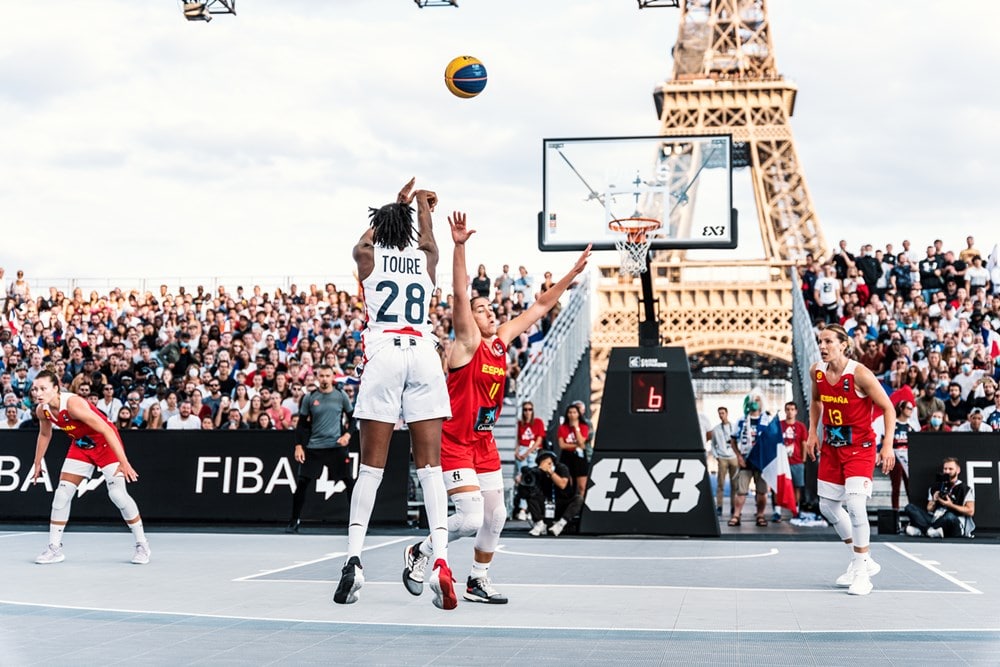
Basketball is one of the most professionalized sports, largely because of the power and global reach of the American NBA. In recent years, a new variation of the sport has been gaining significant momentum: 3×3 basketball. Recently introduced to the Olympic Games at Tokyo 2021, it is played by teams of three on a single basket, and its highly dynamic and visual format has generated genuine enthusiasm among younger consumers, leading to increasingly prominent tournaments being organized around the world.
With its inclusion in the Olympic Games, 3×3 basketball has a promising future. More and more professional players are turning to the discipline because it provides a platform to shine in a more accessible and spectacular format, while also offering opportunities to travel and compete in major tournaments around the world. Other variations of traditional sports, such as rugby sevens, are following a similar path. The development of these alternative formats is now often driven by private initiatives, such as Gerard Piqué’s Kings League, which offers small-sided football matches with much more entertaining rules. The emergence of these new formats is being driven by new consumption patterns imposed by younger generations, who favor short, participatory content consumed through streaming platforms and social media. 3×3 basketball is perfectly suited to these trends.
In France, the FFBB appears to have understood the potential of 3×3 and organizes numerous tournaments for all age groups across the country. This is the case with its SuperLeague and JuniorLeague competitions, held throughout the year across France and enjoying genuine success, particularly during the summer. The development of the discipline in France is also supported by the federation’s INFRA 2024 and Club 3.0 programs. The former aims to support the creation and refurbishment of “playgrounds” — outdoor 3×3 basketball courts — while the latter seeks to bring together all the organizations offering basketball across France: traditional 5×5 and 3×3 clubs, as well as private organizations. There is also a long-term project to establish a structured 3×3 club championship. Currently organized at departmental level, a new geographical tier should be added in each of the coming seasons.
Today, there is no professional club championship in France for 3×3 basketball. Yet the format is already being used by some professional 5×5 clubs as a tool for player development, experimentation and brand building. So what is the best way for these clubs to leverage 3×3, and what can they expect from it in the long term in terms of value creation?
A marketing development tool
3×3 shows significant potential in terms of marketing, brand development and media value generation. The attendance records set during the 2022-23 season are evidence of the strong health of basketball in France, partly explained by the Victor Wembanyama phenomenon at Metropolitans 92 and the two major economic and sporting powerhouses represented by ASVEL and Monaco. But while clubs such as SLUC Nancy and SIG Strasbourg enjoy very high occupancy rates thanks to long-standing loyal fan bases, LNB clubs are now being forced to diversify their audiences because they do not reach the entire basketball-consuming population. Some French clubs are deeply attached to the “family” atmosphere found in many Betclic Élite clubs, but French organizations must also continue to reach the 15-35 age bracket, which increasingly tends to stay away from arenas. The recent TV rights crisis, during which the LNB failed to find a viable buyer, should certainly not be forgotten. Instead, it should be viewed as the starting point for a new way of presenting basketball as a product in France. The potential is clearly there.
3×3 basketball is deeply rooted in urban and hip-hop culture and in the tradition of “street basketball.” Recent competitions have understood this very well: dance battles, rap concerts, graffiti competitions between games — all elements of a culture that is extremely popular among younger audiences and that bring rhythm to every 3×3 event. These initiatives have attracted numerous players to 3×3 basketball and helped develop a pool of talented athletes who could potentially progress into the professional ranks. LNB clubs such as Paris Basketball have already attempted to embrace this urban culture in order to attract new spectators and fill their 5×5 arenas, through rap and dance shows during halftime and communications strongly influenced by hip-hop culture. But this approach could have been taken further through 3×3, with communications specifically focused on this form of the game.
3×3 basketball can attract a new audience that may not yet have been reached by more “traditional” basketball, offering a faster, more dynamic and sometimes more inventive game, freed from some of the tactical constraints of 5×5. It also facilitates another major aspect of modern sports entertainment: strong identification with the personality of individual athletes. The greater creative freedom given to individual players in 3×3 allows each of them to express their own characteristics on the court. An inventive player who loves attempting outrageous moves with a signature move against a rugged, hard-working defender? This type of individual duel can very quickly become highly appealing to spectators. This personalization of 3×3 players can even operate at team level, strengthening the media profile of an LNB club if it succeeds in building a coherent identity around the team.
A financial development tool
3×3 can therefore become a commercial development tool for a club. A new audience means new sponsors and brands could take an interest in the club thanks to a different and more relevant positioning. Clubs could use 3×3 to broaden and complement their sponsorship offering, allowing brands to reach a different target audience, both culturally and in terms of values, while engaging with a demographic that is particularly attractive to them: teenagers and young professionals.
Urban culture is already closely associated with numerous brands and media outlets. Red Bull, for example, could be attracted by the audiences reached through 3×3 basketball. Jordan Brand could also become highly active, as it already is through the benchmark event at the intersection of basketball and urban culture: Quai 54, the world’s largest street basketball tournament. Other organizations that are less naturally associated with these values could see 3×3 as an opportunity to rejuvenate their image. Caisse d’Épargne is a good example: as a partner of the French 3×3 basketball federation, it could be interested in this type of project. The bank has already launched an initiative involving emerging street-art artists to renew its visual identity around 3×3 basketball and strengthen its positioning within the urban culture sphere. On the media side, outlets such as Skyrock, Fun Radio and NRJ France — among the three most-listened-to radio stations among 13-24-year-olds — or even urban radio station Mouv’, could provide new channels for increasing a club’s visibility.
3×3 basketball also creates a new way of selling and presenting clubs’ merchandising ranges. FIBA allows teams to promote their sponsors in innovative ways. For example, sponsors can appear on players through tattoos on their arms. FIBA even allows this communication to be personalized according to the player, their style or their position. Team naming rights are permitted, as is sponsorship of players’ arm sleeves. Brands or partners that do not identify with the LNB championship or with the communication framework imposed by it could therefore be attracted by the opportunities offered by a club’s 3×3 team.
This merchandising potential, similar to what FISE — an event bringing together extreme sports — offers through multiple sales stands for its sponsors during competitions, appears to have a genuine audience and could support a broad range of products connected to this alternative universe: caps, T-shirts, socks and all kinds of merchandise. The concept could go even further, with dedicated jerseys for 3×3 teams, obviously retaining the original club’s colors, brand guidelines and visual identity, but with greater creative freedom and designs created by independent artists, similar to what ASM Clermont 7s has done in rugby. Web3 products could also fit particularly well into 3×3 commercial strategies, targeting a population more familiar with concepts such as NFTs and blockchain than traditional 5×5 consumers.
Finally, although this remains relatively marginal at the financial scale of a professional club today, prize money from international tournaments can also provide a source of revenue to help launch such a project. For example, the world’s best teams can currently earn close to $280,000 over the course of a season. While this is clearly not enough to have a meaningful impact on a club’s cash position, these amounts should increase as 3×3 gains greater media exposure.
A sporting development tool
The final aspect concerns the relevance of 3×3 basketball as a technical development tool for athletes. While this would need to be assessed by the technical staff of a professional organization, several factors suggest that there are meaningful pathways between 3×3 and 5×5.
3×3 is a sport that requires a high degree of versatility from all players, with the concept of positions being much less clearly defined than in 5×5. Every player must be capable of operating in as many different situations as possible. Its fast pace requires a strong ability to make quick decisions, while also demanding concentration and placing significant emphasis on individual development, with direct one-on-one duels at the heart of the discipline. All of this appears consistent with the development required to reach the highest level in 5×5.
LNB clubs could build a team of specialists in the discipline, but from a player-development perspective, their academy and youth-development squads also appear particularly well suited to it. Several players from the French youth championship are already involved with France’s youth 3×3 national teams. Beyond the development aspect, this offers some interesting benefits, including the possibility of creating a strong connection between a city and a club-developed player who has grown up locally and progressed through the ranks before representing their city in an official 3×3 competition. This also echoes the potential to associate each player with a distinctive personality and playing style. It could also provide a new pathway into the professional game for young players coming through a club’s academy.
Everyone is aware of how difficult it is for each generation of academy players to make the transition into professional basketball. Even having a single young player establish themselves at the next level is often considered a success for a club. The FFBB is moving in this direction with the launch this season of its professional 3×3 team, 3×3 Paris. The team consists of six players on fixed salaries and will compete on the future French professional circuit, as well as on the FIBA 3×3 World Tour.
What development models could 3×3 follow?
The development of 3×3 in France remains uncertain and could take several different directions. Several championship formats involving LNB clubs appear interesting, including the idea of staging 3×3 games during halftime of 5×5 matches. But while this already raises logistical and organizational issues, we believe it could have two negative effects.
The first would be to relegate this fast-growing sport to a secondary position behind its bigger brother, 5×5 basketball, whereas the objective should instead be to support its development. The second, and even more important, point is that 3×3 has its own identity and its own codes. It therefore seems relevant to allow it to retain a degree of independence.
The most relevant approach would appear to be the organization of 100% 3×3 events throughout the season, particularly during the spring and summer. Rugby sevens could provide an interesting source of inspiration. These events could then be complemented by the international competitions in which the best LNB 3×3 teams could eventually participate: Manila, Shanghai, Abu Dhabi, and so on. This would help increase the visibility of French clubs on continents that are otherwise difficult to access, as ASM Clermont has done through its sevens team. The Asian market could prove particularly attractive, given the enthusiasm for 3×3 basketball among Chinese and Filipino consumers.
The example of the BIG3 League could also provide relevant inspiration in certain respects for the development of the sport. Founded in 2017 by rapper and actor Ice Cube, it is a professional 3×3 basketball league built around a unique format designed to offer its audience a new experience. It quickly introduced new rules with the aim of making games increasingly spectacular, including the four-point shot. The league takes place over several weeks during the summer, during the NBA offseason, with a regular season and playoffs involving 12 teams. It has succeeded in generating significant interest and attracting the attention of basketball fans, notably through the participation of former NBA stars and a strong social media presence, driven by viral clips of spectacular plays and statements designed to intensify rivalries between players.
The LNB could therefore organize tournaments between its clubs during clearly defined weekend periods and perhaps invite international teams to increase visibility. The LNB already works with platforms such as Twitch, which could therefore provide a first distribution channel for these games while also opening up new revenue opportunities.
Conclusion
One of the key challenges of integrating 3×3 basketball into French clubs and leagues will be to preserve its entertainment value and its distinctive DNA. The sport must not become too “institutionalized” to the point of betraying its spirit as a free, creative and emancipated form of basketball. Building their own team — or even a 3×3 championship involving LNB clubs — would therefore require clubs to focus on several key elements.
The first would be to protect and maintain the emancipatory DNA of the 3×3 format. This would involve promoting the personalities of the players, as discussed above. Emphasizing athletes’ stories and giving them opportunities to interact with fans would help preserve the game’s streetball culture while providing supporters with a more entertaining experience.
Another avenue could be to focus on innovative technologies, which could be used to enhance the entertainment value of a 3×3 championship. For example, new camera angles and more immersive video content could give supporters a different perspective on the action. Augmented reality and other digital technologies could also be used to enhance the fan experience and create a more engaging atmosphere. In turn, this innovative approach could help generate content for 5×5 basketball by driving the evolution of its broadcast and content-production strategies.